
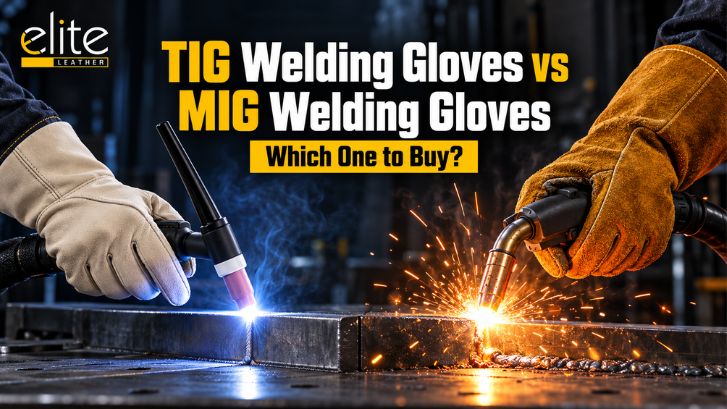
Every welder eventually faces the same decision when choosing welding gloves: should you use a thicker, heat-resistant option or a thinner glove designed for better control? This is where the TIG welding gloves vs MIG welding gloves comparison becomes important.
But the decision starts with understanding how the two processes differ. TIG (Tungsten Inert Gas) uses a non-consumable tungsten electrode and gives the welder precise control, while MIG (Metal Inert Gas) uses a continuously fed wire electrode and is generally faster, with more heat and spatter.
TIG calls for gloves that offer flexibility and fingertip control, while MIG generally requires thicker protection with greater coverage.
At Elite Leather Creations, we manufacture both types of gloves, so in this guide, we’ll compare their construction, protection, dexterity, and ideal applications to help you choose the right pair for your work.
Why the Right Glove Matters
A glove is made to prevent burns, sparks, spatter, and rough surfaces from getting into your hands, and it can also influence the way that you use the torch, gun, or filler rod. If the glove is too bulky, it may not be able to make fine movements, and if it is too light, it may not offer sufficient protection for heavier jobs.
This can be especially seen when comparing TIG and MIG gloves. TIG welders should feel and control the torch and filler rod; MIG welders generally require greater protection from the sustained heat and flying spatter.
MIG vs TIG Welding Gloves: What Is the Difference?
The main difference is the balance between dexterity and protection.
| Feature | TIG Welding Gloves | MIG Welding Gloves |
|---|---|---|
| Main priority | Dexterity and control | Heat and spatter protection |
| Typical design | Thin and flexible | Thicker and more reinforced |
| Finger sensitivity | High | Lower |
| Cuff | Usually shorter | Usually longer |
| Best suited for | Precision welding | Higher-spatter welding |
| Common materials | Soft leather | Heavier leather and reinforced panels |
TIG Welding: Built for Precision
This requires fine hand control. The welder guides the torch with one hand and may feed filler rod with the other, so the ability to move the fingers freely can make a significant difference.
The best gloves for TIG welding are generally thin, flexible, and close-fitting. Soft leather allows better fingertip movement and makes it easier to handle the torch and filler material without the bulk of heavy-duty protection.
At ELC, we made them from soft, unlined leather to maintain flexibility and sensitivity. For detailed work, this type of construction gives the welder better control without adding unnecessary bulk.
MIG Welding: More Coverage and Heat Protection
Generally, MIG generates more spatter than TIG, and welders may be exposed to more heat for a longer duration of time. Therefore, MIG welding hand protection is mainly concerned with durability, coverage, and heat resistance.
They often feature thicker leather and reinforced palms, as well as longer cuffs. More coverage around the wrist and a longer cuff on the lower forearm offers greater protection, and additional leather in high-wear areas increases durability.
For MIG work, a little extra bulk can be worthwhile when it provides the coverage needed for the conditions.
Where Do Stick Gloves Fit In?
Stick welding produces substantial heat and spatter, so stick welding gloves are generally built for protection rather than maximum fingertip sensitivity. They often have thicker leather and longer cuffs, making them closer in design to heavy-duty MIG gloves.
That does not mean a MIG and a stick glove are automatically interchangeable. The correct choice depends on the current, duration of the work, amount of spatter, and level of heat exposure.
If a workshop has TIG, MIG, and stick welding, having a range of hand protection for each process will allow welders to wear a suitable glove instead of having to wear one for every process.
A Practical Example
In a fabrication environment, using the same glove for every process can create practical problems. TIG welders may find bulky gloves difficult to work with, while MIG and stick welders may need more coverage around the wrist and forearm.
Switching to process-specific hand protection allows each welder to use a design suited to the demands of the work. This can improve handling, comfort, and protection throughout the process.
This is why a proper welding glove comparison should consider more than leather thickness. Glove design, fit, cuff length, reinforcement, and the process all matter.
Common Mistakes When Choosing Gloves
Even experienced welders can overlook a few basic factors when buying hand protection. Common mistakes include:
- Using one glove style for every process
- Choosing them based only on price instead of leather quality and construction
- Ignoring fit and allowing excess material to interfere with finger movement
- Choosing short cuffs for work where the wrist and forearm are exposed to spatter
- Overlooking seam placement in areas that receive frequent movement or wear
- Selecting very thick gloves for precision work where dexterity is essential
- Continuing to use them after the leather, seams, or lining have become badly worn
A good one should protect the hand without making the work unnecessarily difficult.
How to Care for Work Gloves
Proper care can help them maintain their flexibility and protective properties for longer. A few simple habits can make a difference:
- Let them air dry completely between shifts if they become damp.
- Store them away from direct sunlight and extreme heat when they are not being used.
- Keep the leather clean and follow the manufacturer’s care instructions.
- Check the palms, fingertips, seams, and cuffs regularly for damage.
- Replace gloves when the leather becomes excessively thin, cracked, or damaged.
Do not continue using badly worn hand protection simply because they are still wearable. Once the material or construction is compromised, the level of protection can also be reduced.
Choose Them Based on Your Process
The TIG welding gloves vs MIG welding gloves choice ultimately depends on what your actual process demands.
At Elite Leather Creations, we understand that welders need hand protection that works with their process rather than against it. Our focus is on durable leather, practical construction, and gloves designed for the demands of industrial work.
FAQs
Q1: What Is the Difference Between TIG and MIG Welding Gloves?
Q2: Are Stick Welding Gloves the Same as MIG Gloves?
Q3: What Leather Is Best for Welding Gloves?
A: Both top-grain and split leather can be used for welding gloves. Top-grain leather offers a smooth feel and good flexibility, while split leather is commonly selected for durability and applications requiring heavier protection. The best choice depends on the process and required protection.
