
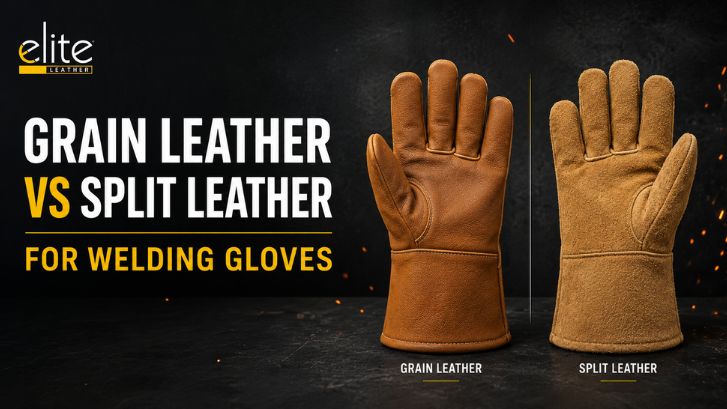
Welding exposes your hands to sparks, heat, abrasion, and hot metal. Therefore, choosing the right leather can make a real difference in comfort and protection. When comparing grain leather vs split leather gloves, it is important to understand how each type performs and where it works best.
Both leather types have a place in welding PPE. However, they differ in texture, durability, flexibility, and abrasion resistance. This guide explains the key differences to help you choose the right option for your work.
What Is Grain Leather?
Grain leather comes from the outer portion of the hide and retains much of its natural grain structure. It offers good durability, flexibility, and a smooth feel, making it suitable for welding gloves that need both protection and hand movement.
Full grain leather is a specific type of grain leather that retains the complete natural grain surface with minimal processing. However, leather type alone does not determine glove performance. Thickness, stitching, lining, cuff length, and heat protection also matter when choosing welding gloves.
What Is Split Leather?
Split leather comes from the layers beneath the outer grain of the hide. Manufacturers separate these layers during leather processing, creating a material with a more textured surface.
It offers good durability and abrasion resistance. Therefore, it is commonly used in welding gloves and other protective equipment designed for demanding industrial work.
Comparing the Two Leathers
Comparing grain leather vs split leather gloves side by side makes the differences easier to understand. Each type offers useful qualities for different working conditions.
Grain Leather
- It has a smoother and more natural surface.
- It generally provides better flexibility and dexterity.
- Works well where hand movement and comfort matter.
Split Leather
- It offers strong abrasion resistance for rough work.
- It has a more textured feel and can provide durable coverage.
- It is best for conditions that involve frequent abrasion and heavy handling.
Because each of them offers different benefits, some welding gloves combine both materials. This approach can provide a practical balance between durability, flexibility, and comfort.
Which Leather Works Better for Welding?
There is no single leather that works best for every welding job. The right choice depends on the type of welding, heat exposure, level of abrasion, and amount of hand movement involved.
When Grain Leather Makes Sense
Grain leather can be a good choice when flexibility and dexterity are important. Its smoother surface provides a comfortable feel and allows workers to handle tools with greater ease.
For welders who regularly perform detailed tasks, this flexibility can make a noticeable difference during long working periods.
When Split Leather Makes Sense
Split leather works well when durability and abrasion resistance are priorities. Its textured structure makes it suitable for demanding industrial environments where gloves face frequent contact with rough surfaces.
It is also commonly used for cuffs and other areas that need additional coverage and durable protection.
What Should You Look for in Welding Gloves?
Leather type is important, but it is not the only factor that determines how well welding gloves perform. At Elite Leather Creations, we recommend looking at the complete glove before making a choice.
Consider these important factors:
- Heat and flame protection suitable for the welding process.
- Sufficient cuff length for the level of exposure.
- Strong stitching in areas that experience regular stress.
- A comfortable fit that allows natural hand movement.
- Suitable abrasion and mechanical protection.
- A lining that supports comfort during extended work.
- Relevant performance ratings and manufacturer specifications.
Welding gloves may carry standards such as EN 388 for mechanical risks and EN 407 for thermal risks. Always check the complete product rating and manufacturer’s information because leather type alone does not determine the protection a glove provides.
Why Glove Construction Matters
Two gloves can use the same leather but perform differently because of their construction. Stitching, thumb design, lining, thickness, cuff length, and reinforcement all affect comfort and durability.
For example, a wing thumb design can provide greater flexibility by reducing seams across the palm. Similarly, a longer cuff can provide additional coverage around the wrist and lower arm.
Conclusion
Understanding grain leather vs split leather gloves helps you choose PPE based on the actual demands of your work. One offers flexibility and a smooth feel, while the other provides durable performance and good abrasion resistance.
At ELC, we offer welding gloves designed for demanding industrial environments. Whether you need the flexibility of grain leather, the durability of split leather, or a combination of both, we focus on reliable protection, comfort, and performance to help workers handle their jobs with confidence.
